By the time Labor Day passes, a lot of summer containers look tired. The petunias have gone leggy, the fillers have flopped, and the whole arrangement seems to know the season is ending. It is tempting to let those pots limp along until frost finishes them off, but early fall is one of the best planting windows we get in Northern Illinois. Cool nights, warm soil, and a fresh round of cold-tolerant plants can turn a fading container into the best display of the year.
The trick is choosing plants and a design built for our climate, not one that only looks good in a catalog photo from somewhere warmer. Here is how to build a fall container that still looks good long after the neighbors have given up on theirs.
Why Fall Containers Fade Early in Northern Illinois
The most common reason a fall container disappoints has nothing to do with effort. It is that the pot was never replanted. Homeowners often try to stretch their summer annuals into October, but those plants simply are not built for it. Warm-season annuals like coleus, most petunias, and tropical fillers start to stall the moment nighttime temperatures drop into the 40s, and the first light freeze ends them entirely.
Fall in the Chicago suburbs also moves faster than people expect. A stretch of mild afternoons can fool you into thinking there is plenty of season left, and then a cold night arrives, and the tender plants collapse overnight. Building a container that lasts means starting with plants that expect the cold and actually look better in spite of it. Once you make that switch, a fall pot can hold its color from September straight through Thanksgiving.
Fall Container Plants That Shrug Off Zone 5 Frost
The plants that carry a fall container are the ones that treat a light freeze as a feature rather than a threat. Many of them can handle temperatures down into the 20s without damage, and several actually deepen in color as the nights get cold.
Reliable choices for Northern Illinois fall pots include:
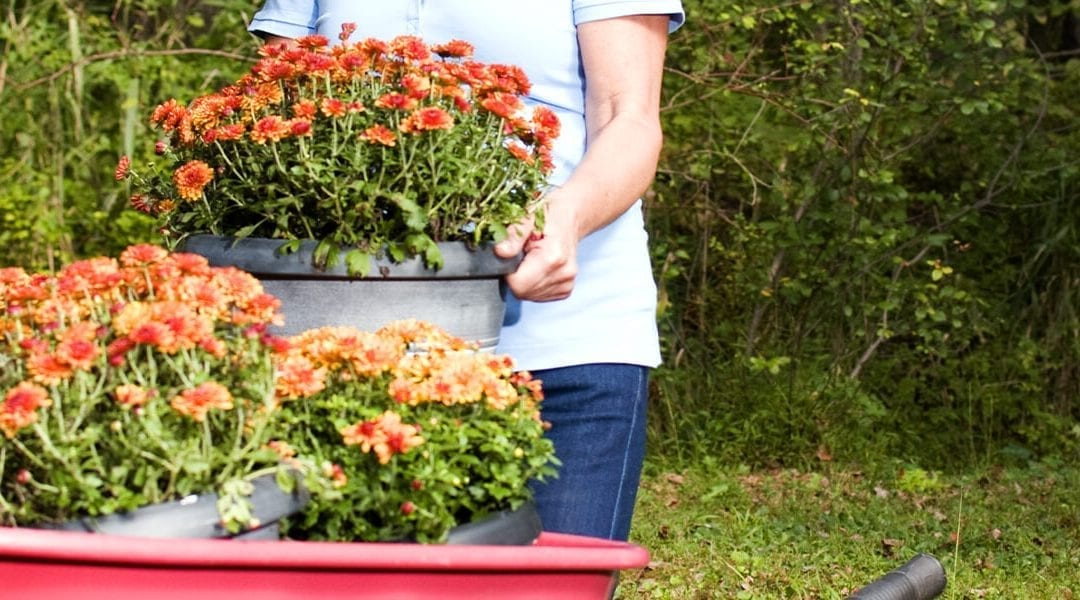
- Garden mums, the classic fall anchor, in the full range of gold, rust, purple, and white. Buy them in tight bud rather than full bloom, and they will last far longer.
- Ornamental kale and cabbage, whose centers turn brighter pink, purple, and cream as the temperature falls.
- Pansies and violas, which shrug off frost and often push a second flush of blooms once the weather cools.
- Asters, for late-season purple and blue that pollinators still visit.
- Heuchera (coral bells), a perennial that brings burgundy, amber, and lime foliage to the mix.
- Dusty miller and ornamental peppers, for silver foliage and unexpected pops of color.
Foliage plants earn their spot here. Once the flowering slows down, texture and leaf color are what keep a fall container looking full and intentional instead of sparse.
It helps to understand why some of these plants improve in the cold. Ornamental kale and cabbage produce their most vivid centers only after a stretch of nights in the 40s and 50s, so a plant that looks a little plain at the garden center in early September often becomes the showpiece of the pot by October. Ornamental grasses behave the same way, holding their plumes and shifting to warm bronze and copper tones as the season turns. That is a big reason grasses have become such a popular fall thriller.
Thriller, Filler, Spiller for Fall Pots
The design formula that makes hanging summer baskets work is the same one that makes a fall container look professional. Instead of petunias, calibrachoa, and other heat-loving annuals, autumn simply swaps in a cast of cold-tolerant plants.
Garden designers often call this formula the Thriller, Filler, Spiller method because every successful container includes:
- a thriller for height
- a filler for body
- a spiller to soften the edges
The easiest way to think of a thriller is as the height and drama in the center or back of the pot. In fall, that often means an ornamental grass, a tall spike, or a dramatic celosia. The filler rounds out the middle with mass and color, which is where mums, kale, and asters do their work. The spiller softens the edges and trails over the rim, a job that ivy, creeping Jenny, or trailing dusty miller handle nicely.
One final fall adjustment matters above all. Because plants grow slowly in cool weather, they will not fill in the way a June pot does. Plan for this ahead of time by planting more densely than you would in spring so the container looks full right away.
5 Fall Planter Recipes Our Designers Build
If you would rather start from a proven combination, these are five of the fall planter recipes our designers build every season. Each one balances a thriller, a filler, and a spiller, and each one is made from fresh fall growth rather than leftover summer plants.
- Lemongrass, ivy, mums, crotons, and red and pink cabbage. The lemongrass gives you height in the center, the ivy trails over the edge, and the cabbage and mums carry the color.
- Japanese blood grass, pink and white petunias, yellow zinnias, and red ornamental peppers. The blood grass is perennial, so this one has a second life we will come back to later.
- A tricolor of cabbages and kale for foliage texture, mixed with pansies in red, yellow, pink, and orange.
- Celosia, textured kale, purple mums, dusty miller, and purple pansies. The deep red celosia keeps growing taller into fall, and the dusty miller adds a cool silver note against the purple.
- Spikes, textured kale, green and yellow ornamental peppers, and purple, white, and orange petunias and pansies. This one leans into the traditional orange and gold of the season.
Use these as written or as a jumping-off point for your own mix. The important part is that every plant is chosen for fall, not held over from summer.
When to Plant for the Suburb Frost Window
Timing is where local knowledge really pays off. Early September is the sweet spot for planting fall containers, because it gives roots a few weeks to settle in while the soil is still warm and the plants can put on a little growth before the days shorten.
Our frost window is also earlier than a lot of people assume, and earlier than the city itself. The National Weather Service notes that the first freeze across the Chicago suburbs typically arrives around October 11 to 12, while the city and the lakeshore often hold off until late October because Lake Michigan and all that pavement trap heat. Out in Bloomingdale, Carpentersville, and Rockford, we are on the earlier end of that range. The Illinois State Climatologist office keeps a helpful overview of how frost timing works across the state, and for a date tied to your exact ZIP code, the Old Farmer’s Almanac Chicago frost date tool is worth a bookmark.
The practical takeaway is simple. Plant your fall containers with cold-tolerant plants and an early frost will not faze them. Keep tender holdovers in the mix, and you are gambling against a freeze that shows up sooner here than it does downtown.
When you do replant, start with fresh potting mix rather than reusing the spent summer soil. Old mix compacts over a season, drains poorly, and can carry over pests or disease, none of which you want going into cool, damp weather. A clean base gives your fall plants the drainage they need right when overwatering is the easiest mistake to make.
Watering and Care as Temperatures Drop
Fall container care is genuinely easier than summer care, as long as you change your habits. The biggest mistake is watering on a summer schedule. Cooler air and slower growth mean the soil stays wet far longer, and too much water combined with cold temperatures can rot roots. University of Illinois Extension recommends watering fall pots only when the top inch of soil is dry rather than on a set routine, which is the opposite of how you managed your summer containers in July.
A few other cool-weather habits keep things looking sharp. Pinch off spent mum blooms and tired pansy flowers to encourage the next round. Go light on fertilizer, since you are maintaining the display rather than pushing new growth. And keep an eye on the forecast. If an unusually hard early freeze is coming before your plants have hardened off, pulling containers under a porch overhang for the night is cheap insurance.
What to Do With the Pot After Halloween
Here is the part most fall container guides skip. Your pot does not have to end with the jack-o-lanterns. When the mums and pansies finally give out, that container is the perfect base for a winter arrangement. Swap the spent annuals for cut evergreen boughs, birch branches, and berry stems, and you have a display that carries you through the holidays. Our evergreen collection is where a lot of those winter greens come from.
The container itself needs a plan too. Illinois Extension notes that large concrete and wood planters can safely stay outdoors through a Northern Illinois winter, but ceramic, terra cotta, and thin resin pots crack when wet soil freezes and thaws. Those should be emptied and stored upside down once you are done with them.
And remember that Japanese blood grass from recipe number two. Because it is a perennial, you can transplant it into a garden bed after the container season ends, mulch around it, and watch for it to return in spring. It is a nice way to get a second season out of a plant you already bought.
Where to Build Your Fall Containers in Chicagoland
The best fall container is the one matched to your space, your light, and how the season actually behaves where you live. If you are not sure where to start, bring a photo of your porch or patio, and we will help you choose plants that will hold up from planting day through the first hard freeze.
Stop by one of our garden centers in Carpentersville, Bloomingdale, or Rockford to see this season’s fall plants in person, pick up a designer-built planter, or gather everything you need to build your own. If your fall refresh is part of a bigger project, our landscape design and installation team can help you carry that color into the beds around your home too.
Let’s grow something great this fall.